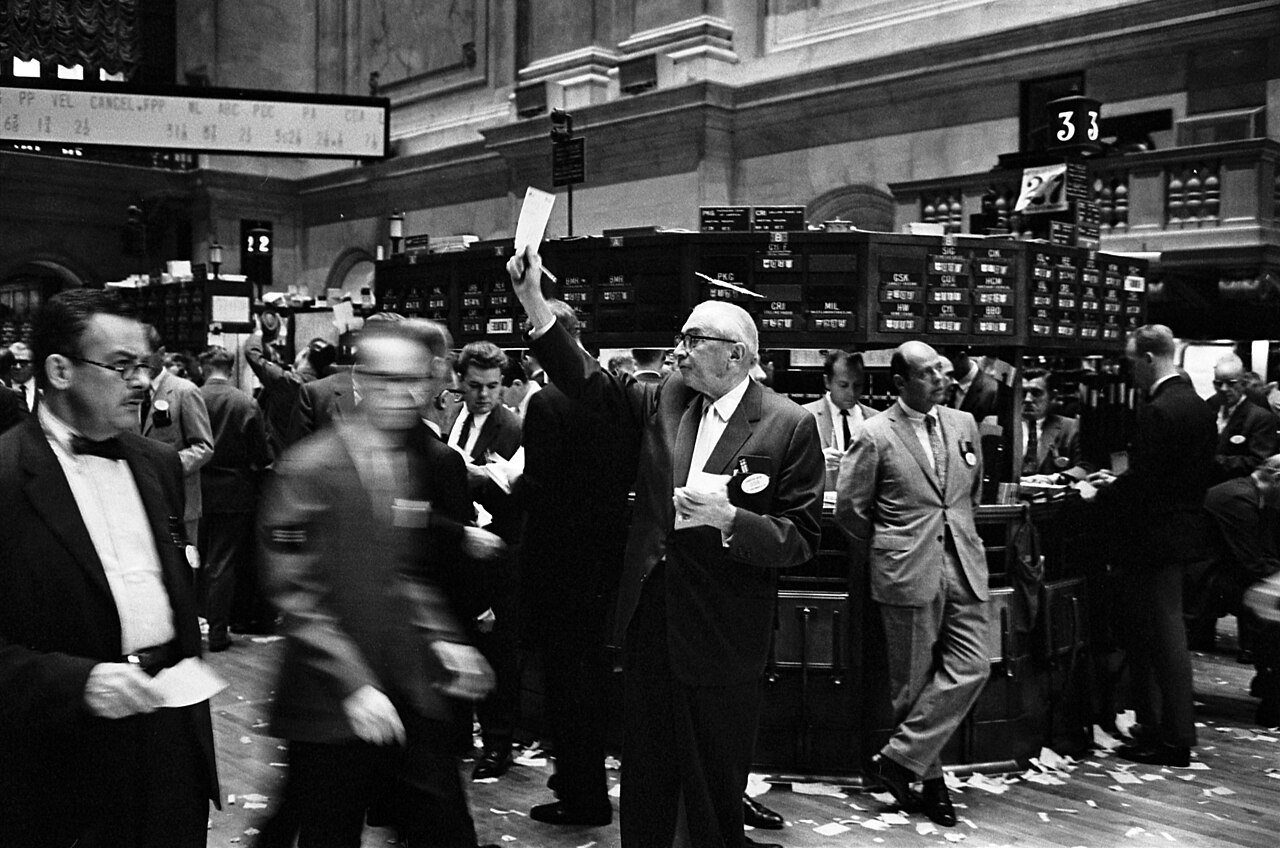
Photo: Thomas J. O'Halloran, U.S. News & World Report, public domain, via Wikimedia Commons
On Monday, October 19, 1987, the Dow Jones Industrial Average fell 508 points and closed at 1,738.74. That was a drop of 22.6% in a single session, and it is still the worst one-day percentage fall in the index's history. The day got its name almost immediately: Black Monday.
To put the number in perspective, the Dow lost a little under 13% on the worst day of the 1929 crash. Black Monday was close to double that. And yet, and this is the part that surprises people, the American economy did not fall into a recession afterwards, and the Dow actually finished 1987 a little higher than it started.
This week is the 39th anniversary, which makes it a good moment to look at what happened, why it happened so fast, and the rules it left behind that still shape how markets behave on a bad day.
The week before the crash
Black Monday did not come out of a clear sky. The market had run up hard through 1987, and the Dow hit a then-record high of about 2,722 in late August. By October, worries were piling up: rising interest rates, a large US trade deficit, and a weakening dollar.
Prices slid through the week of October 12. On Friday, October 16, the Dow fell 108 points, which at the time was a big one-day drop. Then traders went home for the weekend with the bad news sitting on their desks.
When markets opened in Asia on Monday, selling started there first. Hong Kong fell so sharply that its exchange then closed for the rest of the week. By the time New York opened, sell orders had stacked up so heavily that many stocks could not even start trading on time.
How portfolio insurance made it worse
The headline cause most people point to is a strategy called portfolio insurance. Big investors used computer models that told them to sell stock index futures as prices fell, in order to limit their losses. In theory this protected each individual fund. In practice, when everyone running the same playbook sold at once, the selling pushed prices lower, which triggered more selling.
That feedback loop is the reason the decline was so fast. Program trading, where computers fire off large baskets of orders automatically, sped the whole thing up further. The New York Stock Exchange handled more than 600 million shares that day, a record at the time, and its systems and specialists were overwhelmed.
A presidential task force led by Nicholas Brady, usually called the Brady Commission, studied the crash and reported in early 1988. It singled out portfolio insurance and the poor coordination between the stock market and the futures market as major factors. Economists still argue over how much weight each cause deserves (my own view is that no single villain explains a fall that big), but the outline of the story is well accepted.
The Fed's one-sentence answer
The Federal Reserve had a brand-new chairman. Alan Greenspan had taken the job only that August. Before markets opened on Tuesday, October 20, the Fed released a short statement affirming "its readiness to serve as a source of liquidity to support the economic and financial system."
That one sentence did a lot of work. Banks were reassured that cash would be available, so they kept lending to the brokerage firms that needed it to settle trades. The market was shaky for days afterwards, but the panic did not spread into the wider financial system the way many people feared it would.
Promising cash quickly and in plain words became a template. Central banks have reached for versions of it in nearly every market scare since.
Circuit breakers and other rules it left behind
The most visible legacy is the circuit breaker. After 1987, US exchanges introduced rules that pause trading when prices fall too far, too quickly, so that buyers and sellers have time to catch their breath.
Today's market-wide circuit breakers are tied to the S&P 500. A fall of 7% from the previous close halts trading for 15 minutes, a 13% fall triggers another 15-minute pause, and a 20% fall stops trading for the rest of the day. They were triggered several times in March 2020, during the early weeks of the pandemic, which is the closest modern investors have come to Black Monday's speed.
Exchanges and clearing houses also upgraded their systems and tightened coordination with the futures markets, the two weaknesses the Brady Commission flagged.
How long the recovery took
This is where Black Monday parts company with 1929. Within two days the Dow had won back a good chunk of the loss, and it closed out 1987 with a small gain for the year. It took until 1989 to climb back above the August 1987 peak, so roughly two years, which is short by the standards of big crashes.
Someone who sold everything in a panic on October 19 locked in the loss. Someone who held on, uncomfortable as that surely was, was back to even within a couple of years. That is not a promise about any future crash, and markets have had much longer recoveries (Japan's Nikkei took decades to regain its 1989 high), but it is part of the record.
What Black Monday means for savers today
None of this is personal financial advice, and the right choice depends on your own situation. But a few points from 1987 are worth keeping in mind.
A 20% fall in one session has happened, and a well-built savings plan assumes it could happen again. Money you will need in the next year or two arguably does not belong in shares at all.
Circuit breakers slow a crash down without stopping it. The pauses exist to stop panic feeding on itself, which is also a decent rule for individual investors: if you feel the urge to sell everything on a terrible day, it is worth waiting until the next morning before deciding anything.
And the dull habits, like diversification and keeping an emergency fund, are still the ones that make a day like Black Monday survivable. I realise that is a dull way to finish a story about the worst day in the Dow's history, though dull is more or less the point of an emergency fund.
Enjoyed this story?Get a new one every day on social.