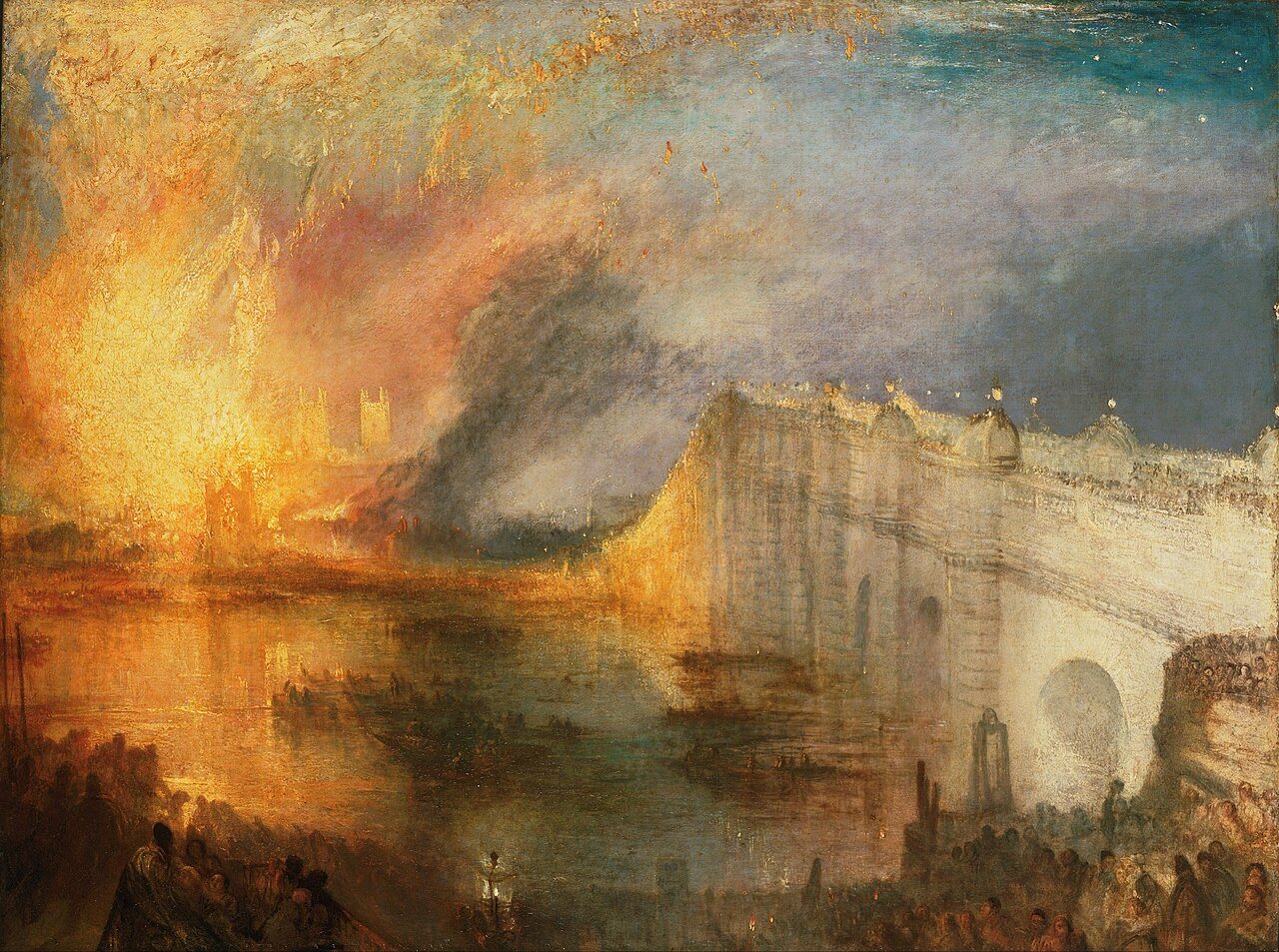
J.M.W. Turner, The Burning of the Houses of Lords and Commons, public domain, via Wikimedia Commons
On the morning of October 16, 1834, two workmen went down to the furnaces under the House of Lords in Westminster with a cartload of old wooden sticks. Their job was simple: burn the lot. They fed the furnaces all day. By early evening the flues were dangerously hot, the wood panelling above them caught, and by the next morning most of the old Palace of Westminster, home to both houses of Parliament, was a shell.
The sticks were tally sticks. For roughly six centuries they had been the official way the English treasury recorded money paid in and money owed. They were retired, then forgotten in a storeroom, and finally disposed of in about the worst way anyone could have chosen.
I have read a lot of strange money stories, and this is still my favourite, partly because it is true and partly because it reads like a parable about bureaucracy written by someone with a grudge.
How a notched stick worked as a receipt
A drawing of a medieval Exchequer tally stick with notches cut into one end and handwriting along its side. Illustration from the 1911 Encyclopaedia Britannica, public domain, via Wikimedia Commons
A tally was a squared length of wood, usually hazel. When someone paid money into the Exchequer, a clerk cut notches across the stick to record the amount. Wider notches meant larger sums, narrower ones smaller sums, so the size of a cut told you whether you were looking at pounds, shillings or pence. The date and the payer's name were written on the side in ink.
Then came the clever part. The stick was split lengthwise down the middle, straight through the notches. Each half carried exactly the same marks. The payer kept the longer piece, called the stock, and the Exchequer kept the shorter one, the foil. When the time came to settle up, the two halves were fitted back together. If the grain and the notches lined up, the record was genuine. Wood grain is very hard to fake, which made this a surprisingly good anti-fraud system for the Middle Ages.
Word historians link that system to some English we still use. The holder of the stock was owed money by the crown, and "stock" in the financial sense is often traced back to it. "Counterfoil," the stub you keep from a cheque book, also points back to the foil. Some of these derivations are debated, so treat them as likely rather than certain.
Six centuries of accounts on wood
The Exchequer was using tallies by the 12th century, and the system lasted far longer than anyone would expect. Tallies also did a second job. Because the crown honoured them, they could be passed on to someone else, which turned them into a kind of IOU that circulated. Lenders sometimes accepted them at a discount, a little like a bond.
By the late 1700s the whole thing looked absurd next to modern paper bookkeeping. Parliament passed an act in 1782 to abolish tallies, but with a very British delay: the change would take effect only when the officials who held the relevant posts had died or retired. That did not happen until 1826. For more than forty years the reform sat waiting.
The order to burn them
By the early 1830s, the Exchequer had stores full of obsolete tallies, centuries' worth of them, sitting in Westminster. In 1834 the decision was made to get rid of them. Charles Dickens, mocking the episode in a speech two decades later, suggested the obvious answer would have been to give the wood to poor Londoners as firewood. Instead the sticks were burned on site, in the stoves that heated the House of Lords.
The heating system was not built for that kind of load. The workmen kept stuffing the furnaces, and the copper flues running up through the building got hotter and hotter. Visitors touring the Lords that afternoon reportedly complained of heat and smoke coming up through the floor. Nobody stopped the burning.
The night Westminster burned
Fire broke out a little after six in the evening. It spread fast through the old timber and panelling of the House of Lords, then to the House of Commons. Crowds gathered on the bridges and riverbanks to watch, and the fire burned through the night.
Firefighters and soldiers concentrated on saving Westminster Hall, the great medieval hall that dates back to the 11th century, and they managed it. Most of the rest was lost. J.M.W. Turner was among the onlookers, and he painted the scene more than once. The canvas at the top of this page is one of those paintings.
What replaced the old palace
The fire led to the building most people now picture when they think of London. A design competition was held, and the architects Charles Barry and Augustus Pugin won with the Gothic Revival palace that stands today, including the clock tower that holds Big Ben. Construction took decades and cost far more than planned (some things about government spending are older than tally sticks).
Where you can see tallies today
Not every tally went into the furnace. A number survive in British collections, including The National Archives at Kew and the Parliamentary Archives, and they turn up occasionally in museum displays about money and record keeping.
If there is a practical lesson here, it is a dull but useful one: old records need a disposal plan before they need a bonfire. Shred paper statements properly, delete old files on purpose rather than by accident, and if you ever inherit a cupboard full of mysterious financial paperwork, find out what it is before you throw it away.
Enjoyed this story?Get a new one every day on social.