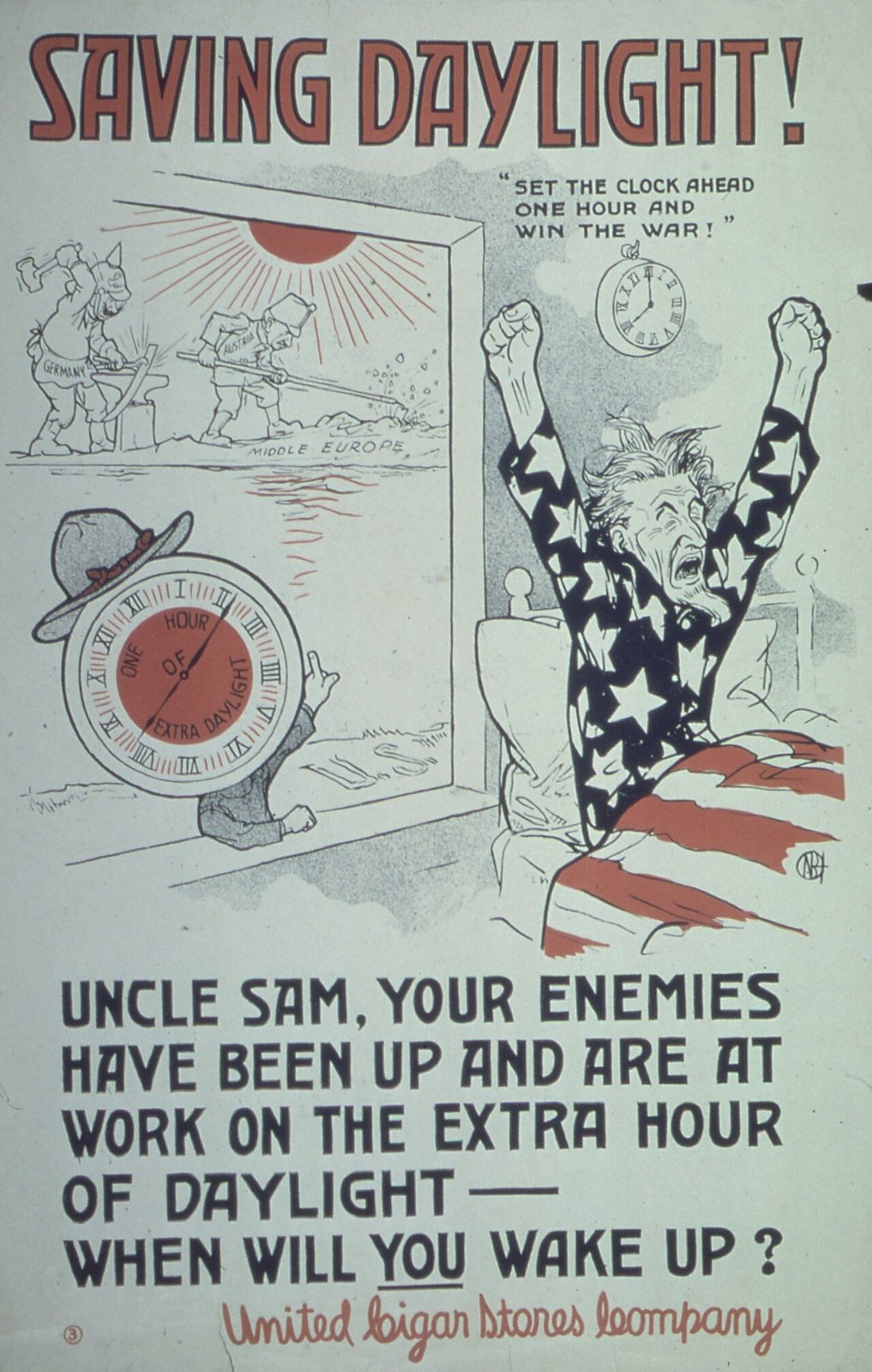
United Cigar Stores Company poster, about 1918, public domain, via the U.S. National Archives and Wikimedia Commons
If you woke up this morning a full hour before your alarm, you were probably in Europe. Clocks across the European Union and the UK went back one hour overnight, as they do on the last Sunday of every October. In the United States and Canada the same thing happens next Sunday, November 1, at 2 a.m.
For something so routine, the twice-a-year clock change has an oddly heated history, and most of it is about money. It was introduced to save fuel, extended partly at the urging of businesses that expected to sell more, and it is argued over in Congress to this day.
This year the fight came closer to an ending than it has in a while. It still has not quite got there.
The wartime coal pitch
People like to credit Benjamin Franklin with the idea. That is a stretch. In 1784 Franklin wrote a letter to a Paris newspaper joking that Parisians could save a fortune in candles by getting up earlier, and suggesting cannons be fired at sunrise to help them along. It was satire, and he never proposed moving the clocks.
The serious push came later. A British builder named William Willett campaigned for it in a 1907 pamphlet called "The Waste of Daylight," but it took a war to make it law. Germany and Austria-Hungary moved their clocks forward in April 1916 to save coal, and Britain followed within weeks. The United States adopted it in 1918, with posters like the one at the top of this page telling Americans that setting the clock ahead would help win the war.
The American version did not last. Farmers, whose day runs on the sun and not the clock, disliked it, and Congress repealed national daylight saving time in 1919 over President Wilson's veto. It came back during the Second World War as year-round "War Time," vanished again, and was only made reasonably uniform by the Uniform Time Act of 1966.
The energy savings are real, but small
The core economic argument has always been energy. If it stays light later in the evening, the theory goes, people switch on fewer lights and the country burns less fuel.
When the US extended daylight saving time by about four weeks in 2007, Congress asked the Department of Energy to measure what happened. Its 2008 report found electricity use fell by roughly half a percent on each extra day of daylight saving time. Over a full year that worked out to about 0.03 percent of the country's electricity. That is a real number, but it is not the sort of figure that changes anyone's bill in a way they would notice.
Other research has been less kind. Economists Matthew Kotchen and Laura Grant studied Indiana, which adopted daylight saving time statewide only in 2006, and found household electricity use went up by around 1 percent, because extra air conditioning on bright evenings and extra heating on dark mornings outweighed the savings on lighting. Lighting is simply a much smaller share of household energy than it was in 1916.
Who actually makes money from the extra hour
If the energy savings are modest, the case for daylight saving time has had plenty of other backers. In his history of the subject, "Spring Forward," the writer Michael Downing traced how retailers, the golf industry and makers of barbecue equipment pushed over the decades for longer evening light. The logic is simple enough. People shop, play a round and grill when it is light out after work.
The best-known example is candy. When Congress was debating the 2007 extension, confectioners lobbied for the change to run past Halloween, so trick-or-treaters would get an extra hour of daylight. The final law moved the end of daylight saving time to the first Sunday in November, which is why Halloween in the US now falls before the clocks go back. (I am not saying the candy industry runs the calendar. I am saying it asked, and it got what it asked for.)
Where the permanent fix stands
Plenty of people would rather stop changing the clocks altogether. The European Parliament voted in 2019 to scrap the seasonal change, but member governments never agreed on how, and the plan has sat untouched since.
In the US, the Sunshine Protection Act would make daylight saving time permanent. The Senate passed a version by unanimous consent in 2022 that then died in the House. This year it went the other way: the House passed the bill 308 to 117 on July 14, 2026, and President Trump has said he supports it. The Senate, however, has not voted, and several senators have said publicly they oppose it. Sleep scientists have their own objection. The American Academy of Sleep Medicine argues for permanent standard time instead, on the grounds that darker mornings are the bigger health problem.
So for now, nothing has changed. American clocks go back next Sunday.
A few things worth doing this week
The clock change is a small event, but it is a good prompt for a few checks that can save money or trouble.
If you have a smart thermostat, timers on a water heater or lights, or an electric car set to charge overnight, check that they moved with the clock. Most connected devices do it themselves. Older plug-in timers and some car clocks do not, and a heater or charger running at the wrong hour can cost you, especially if your electricity plan charges more at peak times.
If your utility uses time-of-use pricing, look up when its peak hours run. They are set by the clock, so once evenings get dark earlier, your heaviest use of lights and cooking may land squarely in the expensive window.
And many fire services suggest using the change as a reminder to test smoke alarms. It takes a minute, and nobody needs an extra hour of sleep badly enough to skip it.
This article is general information, not personal financial advice.
Enjoyed this story?Get a new one every day on social.